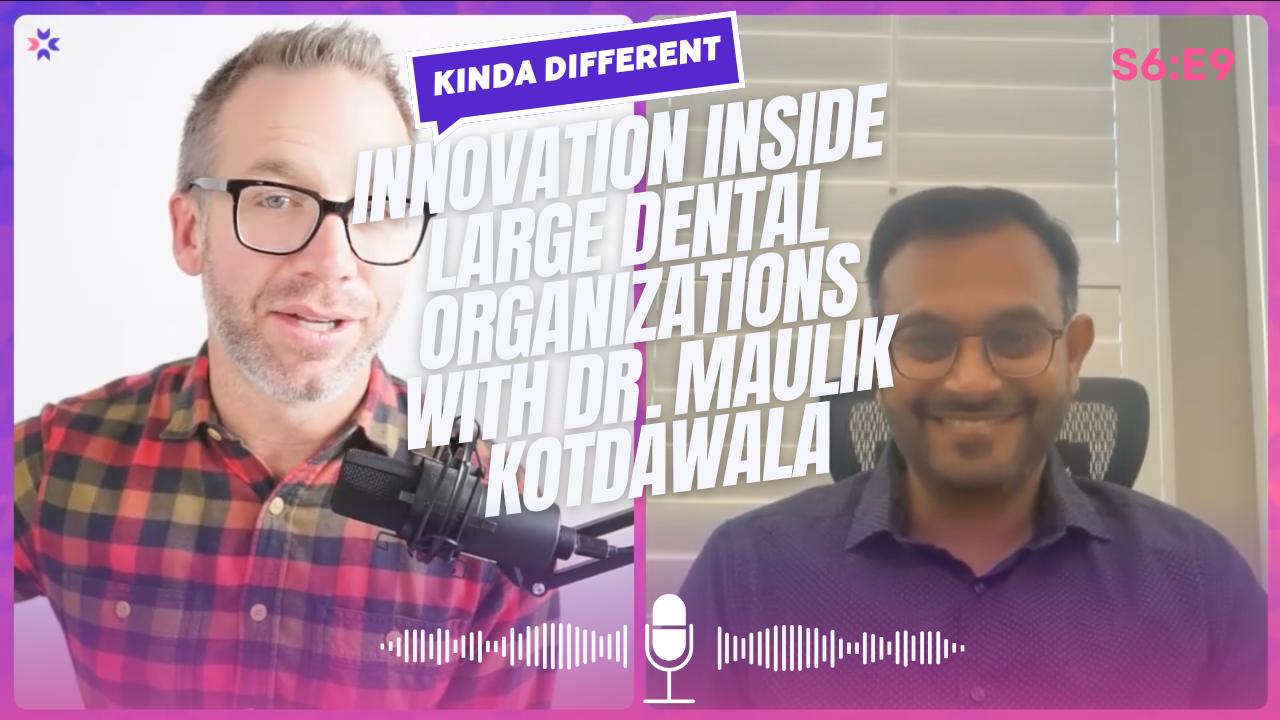
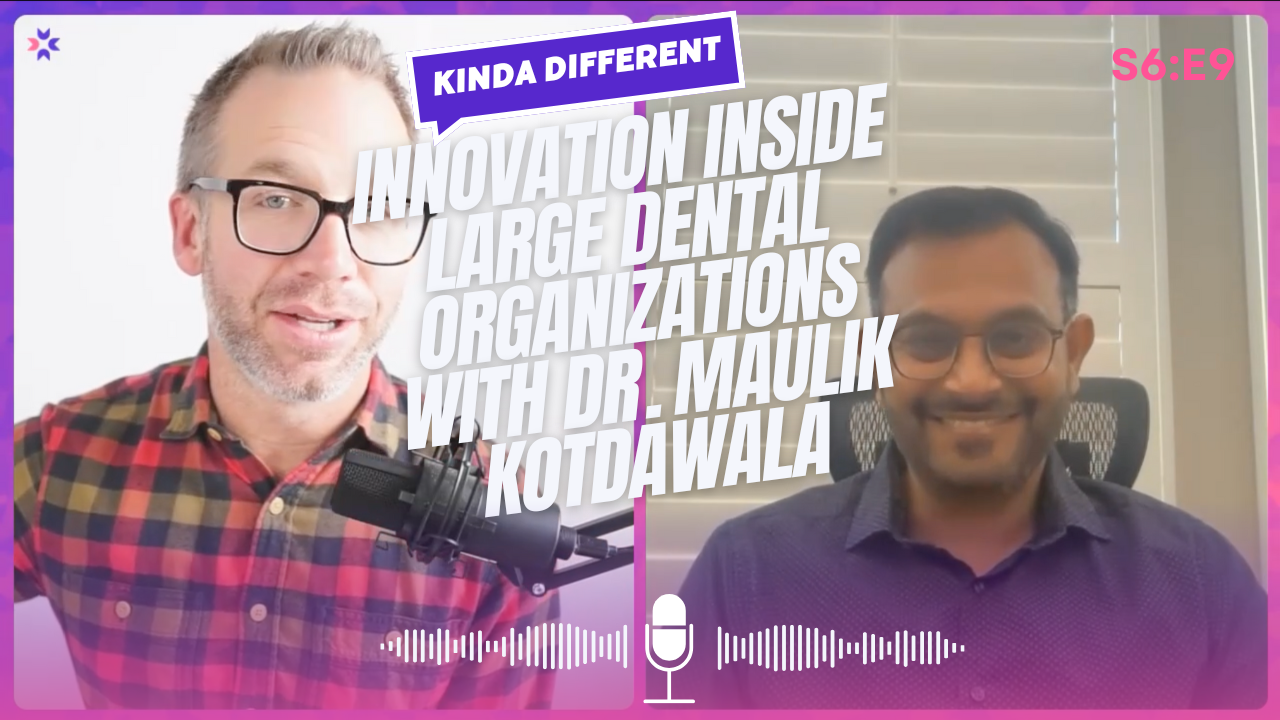
Innovation, Prevention, and Making Dentistry More Human with Dr. Maulik Kotdawala
This episode of Kinda Different explores how Dr. Maulik Kotdawala, dentist and Director of Operational and Clinical Strategy at Advantage Dental+, drives innovation inside a large organization while keeping patient safety, prevention, and trust at the center.
He and Matt talk about what it takes to move a “dental aircraft carrier,” how to align shiny new tech with real strategy, what he learned training in both India and the United States, and why doing the right thing for patients is also good business. Maulik shares how his team uses data, dashboards, and practice visits to reduce caries risk at scale and make dental care more human for patients and providers.
Watch below, listen on Spotify or Apple Podcasts, or read the transcript at the bottom of the page.
Key Questions This Page Answers
- How can clinicians influence innovation inside large dental organizations and DSOs?
- What makes innovation harder in big systems, and how do you move faster without cutting corners?
- How did Maulik’s training in India and the U.S. shape his clinical philosophy and focus on prevention?
- Why is “do what is right for the patient” both an ethical and financially sound strategy?
- How can data, dashboards, and prevention initiatives reduce caries risk across a population?
- What does it look like to make dentistry more human from a leadership role, not just chairside?
Episode Snapshot
- Guest: Dr. Maulik Kotdawala
- Role: Director of Operational and Clinical Strategy, Advantage Dental+
- Background: Dentist trained in India and the U.S., former community health clinician and practice director, Ross School of Business graduate, now focused on care delivery transformation and clinical strategy
- Host: Dr. Matt Allen, CEO and co-founder, DifferentKind
- Show: Kinda Different – conversations about innovation in dental care and making healthcare more human
- Topics: Innovation in large organizations, prevention, caries risk, AI and tech evaluation, cost and quality, culture, and human-centered leadership
Key Topics Covered
- Maulik’s journey from growing up above his parents’ clinic in India to clinical leadership in a U.S. DSO
- What innovation really looks like inside large dental organizations, beyond the startup myth
- How to decide which new technologies are worth testing, especially AI tools and “agents”
- The tension between cost control, private equity expectations, and maintaining high-quality care
- Why prevention and caries risk reduction are central to his definition of success
- How doing the right thing for patients builds trust, retention, and long-term business value
- Using data and dashboards to see impact when you are no longer in the operatory every day
- The role of practice visits, listening, and collaboration when leading change from the center
- What it means to build a “life well lived” in dentistry and healthcare
Episode Highlights
- Growing up literally inside healthcare
- Living above his parents’ clinic and seeing surgery and inpatient care from a young age
- How that early exposure made “do what is right for the patient” the family rule
- Training as a dentist in India and then in the U.S.
- High-volume, resource-limited public programs and getting very strong at diagnosis
- Later layering on crown, bridge, implants, aesthetics, and higher patient expectations in the U.S.
- How these complementary experiences shaped his preventive and diagnostic focus
- Innovation inside a large organization
- Aligning any product or idea to the 50,000-foot strategy before anything else
- Building a credible business case and working with IT, risk, and compliance
- Being realistic about why bigger systems move slower and why some friction is healthy
- Evaluating shiny objects, especially AI agents
- Why patient safety, patient experience, and provider safety are the non-negotiable pillars
- The risk of hallucinations and bad guidance when AI tools are not vetted carefully
- Why many patients still want a human on the other end of the line
- From speedboat to aircraft carrier
- Startups versus DSOs: what changes and what does not
- The importance of education, neutral evaluation, and avoiding confirmation bias
- Building consensus so that once people buy in, they truly own the change
- Prevention, caries risk, and data
- How his organization launched a prevention initiative focused on caries risk and upstream care
- Watching moderate and high caries risk shift downward in the data over a year
- Why this is one of the most gratifying parts of his work and a clear example of large-scale impact
- Making care more human from a leadership role
- Why visiting practices, listening, and hearing the “good, bad, and ugly” matters
- Letting solutions come from people in the practices, not just the corporate center
- Using trust, respect, and collaboration to de-risk innovation and support teams
- A life well lived in dentistry
- Helping patients, coworkers, and communities live healthier, more fruitful lives
- Seeing data and prevention metrics as proof that this is happening
- Keeping that north star at the center of operational and clinical strategy decisions
Guest Bio
About Dr. Maulik Kotdawala
Dr. Maulik Kotdawala is the Director of Operational and Clinical Strategy at Advantage Dental+. Trained as a dentist in India and later at Tufts in the United States, he has practiced across DSOs and community health centers, including serving as a practice director.
After earning his MBA from the Ross School of Business at the University of Michigan, Maulik moved into clinical leadership to scale his impact beyond the chair. His work focuses on care delivery transformation, prevention and caries risk reduction, and aligning innovation with patient safety, provider experience, and organizational strategy.
He is passionate about using data, thoughtful innovation, and frontline listening to make dental care more human at scale.
FAQs
Q1. How can dentists drive innovation inside large dental organizations?
By aligning proposed products or workflows with the organization’s strategy, building a clear business case, collaborating early with IT, risk, and compliance, and bringing a clinical lens to cross-functional work. Maulik stresses that innovation must serve patient safety, patient experience, and provider safety, not just novelty.
Q2. Why does Maulik emphasize prevention and caries risk in this episode?
His team focuses on catching and addressing problems further upstream. By scaling caries risk assessment and preventive interventions, they are seeing measurable shifts in caries risk categories across large patient populations, which is both clinically meaningful and a strong population health signal.
Q3. What lessons does he draw from training in India and practicing in the U.S.?
High-volume, resource-limited training in India sharpened his diagnostic skills and comfort with doing more with less, while U.S. practice expanded his experience with restorative, aesthetic, and implant dentistry. Together, these experiences reinforce a philosophy of accurate diagnosis, prevention, and doing what is right for the patient.
Q4. How does he think about private equity and cost control in dentistry?
Maulik acknowledges that every business must focus on cost, but warns that indiscriminate cost cutting can damage morale and patient experience. He argues that reducing unnecessary spend is positive as long as quality of care and team wellbeing remain protected.
Q5. What does it mean to “make dental care more human” from a strategy role?
For Maulik, it means visiting practices, listening deeply, co-creating solutions with frontline teams, and tracking outcomes that matter for patients and providers. It also means using data not just to improve margins, but to show that more people are getting preventive care and living healthier lives.
Transcript
What's up, everyone? Welcome back to another episode of Kinda Different, a podcast where we talk about innovation and dental care. We connect with some absolutely amazing folks today, there's no exception, and we talk about how we can all together make dental care more human.
You've heard the spiel. I'm Dr. Matt Allen. I'm the CEO and co-founder of DifferentKind, and your host for Kinda Different.
And I am thrilled to have a conversation today with somebody who I've gotten to know over the last few years and who is really operating in an interesting space, somebody who is a dentist, but also operates in kinda different ways now and operates in different states in terms of where his clinics are kind of located and has some different kind of thoughts there. So just really thrilled to have a conversation today that I think will be kind of really broad spanning and interesting. So really excited to introduce everyone to Maulik Kotdawala.
Did I get that right? Okay, perfect. Yeah, I like make sure Director of Operational and Clinical Strategy at Advantage Dental Plus and yeah, somebody like I said, who I respect a lot and I'm excited to have on.
So thanks for joining us, Maulik.
Absolutely.
Yeah, can you just give us a little bit more info on who you are and beyond just name and title and then we'll dive in.
Awesome. Thanks, Matt, for having me on the podcast. Both my parents are doctors.
I grew up with my parents running their own inpatient consulting facility with an OR on the second floor. We lived on the first floor, so healthcare has been kind of integral ever since I was a child. So that inspired me to get into healthcare.
My dad's a neurosurgeon. I always wanted to become a dentist. I did.
So I was a dentist back in India, came here to the US, went to Tufts and then practiced at a DSO, moved to a community health center, practiced there for a bunch of years. And while I was the director for that practice, I wanted to go to business school because I wanted to understand the full picture of what the business of dentistry is. Graduated from Ross School of Business, University of Michigan, Go Blue, a few years ago, and transitioned out to a clinical leadership role at Advantage Dental Plus.
And the goal was, how can I help scale my impact beyond being chair-side? As a chair-side clinician, you see about 2,500 visits a year. But in the role that I'm in now, I'm able to help more people.
It's not chair-side, but then bringing in the clinical lens and then working cross-functionally with different departments and having a deeper understanding of what each of them do helps me, whether it's care delivery transformation or just meeting our objectives and serving our communities and our patients.
Awesome, man. Well, yeah, so, I mean lots, lots of different experience there, right? Across, you know, different countries, different, you know, care models, and now kind of bringing different care models in and thinking about that.
So love all of that. And, you know, I think we're gonna have a great conversation. So let's dive in.
Yeah, first kind of about innovation and you kind of mentioned this idea, and we've talked a lot about this outside of, you know, this podcast as well. But just kind of the idea of, you know, I think when we think about innovation, and we've had a lot of folks on the podcast who are the person who, you know, is responsible for bringing in care innovation, right? So they might be the owner of the DSO.
They might be the owner of the clinic, whatever it might be. And it's like, cool. You know, we had Jeremy, who's a good friend of ours, on, you know, the first episode of the season, and it's like, Jeremy owns his own practice, right?
And so he can do whatever he wants, and he can just make those decisions. You are not in that situation right now, right? So what have you found?
You know, I think innovation is different in different spots, right? And so I think one of the things that sometimes happens when we think about kind of bigger enterprises and, you know, whatnot is this is, it's, there's more cooks in the kitchen. It's harder to get things through, you know, whatever.
So what have you learned in terms of operating? Because we need that, right? Like we need big organizations to be innovating.
We need big organizations to be thinking about what's next. What have you learned in your current role in terms of how to best make those kinds of things happen?
Sure. Yeah, that's a great question. Firstly, I'd like to say the thoughts that I'm going to share are my own.
They don't reflect those of my employer or the organization that I work for. But yeah, your question, you know, we, over the last few years, we've seen so many new things that have come into sight, whether it's technology, whether it's materials, whether it's, you know, new clinical workflows. Being a part of a larger organization, I think it's important to understand what, you know, what the 50,000-foot view is, right?
Where does the leadership want the organization to go, right? And if you are a part of that leadership, it's incumbent upon us as clinicians, and if not as clinicians, as business leaders, to make sure that at the end of the day, we are entrusted with caring for people and taking care of their health, understanding what the biggest strategy is, and then the question that I ask myself is, what must be true for the strategy to then become impactful, right? So when it comes to the execution aspect, and so in my current role, trying to bring in innovation into our business and our practices, is just working with all the different departments, right?
Whether it's marketing, whether it's finance, whether it's analytics, but it comes from a unique position of being a former clinician, having practiced for almost two decades, you understand things a little differently in how the impact that other business departments make can have on our clinicians, on our folks in the practice, and eventually on our patients, right? So, and there's a lot of shiny objects out there. But which ones are worth pursuing and not worth pursuing?
Everybody's trying to make a great pitch, and there's some great stuff, but also making sure that we are being diligent when we approach some of these newer technologies. And one example that I can use is there's AI agents who can do a whole bunch of stuff, whether it's scheduling appointments or there was at least one product where it's kind of like WebMD, but it answers questions and guides you where you may want to go for care, right? We know that these AI agents can hallucinate and can give responses that can be super erratic.
So, just making sure that you've done your part, so that when the patient calls in or, you know, patient is leveraging that or interacting with that service, they have as good of an experience as possible. My personal philosophy is, you know, Paramount is, we take care of our patients, the patient experience, patient safety, and provider experience, provider safety. And I believe we need to stand our business on those pillars, so that, I mean, it's fundamental, right?
That's why we exist, either as a clinician or as a business. And if we can do that and approach innovation from that lens, I think that would serve us well.
That's interesting. I have a couple of follow ups there. An interesting thought on kind of AI agents, especially in the scheduling realm, right?
Which I think is like huge in dentistry right now. And I don't think we've actually talked about that a ton this season on the podcast. But, you know, I saw some research recently that was showing that like 95% of people when they like are talking to an AI agent are immediately like, let me talk to somebody else, right?
And you're like, let me talk to someone at the office. And you're like, that's great, like to your point, but there's a lot of shiny objects out there. You like might take a lot of time, energy, effort, like implementing something like that.
And it literally doesn't, you know, impact, you know, the number of people that you want and whatever, right? So you have to be thoughtful in that way. I think one of the things that we see and I think we certainly all feel, right, is, you know, kind of the, you know, when you work for a startup and it's small, right, like you can make decisions really quickly, you can pivot really quickly, things can change, right?
And when you work for a bigger organization, right, it's, you know, it's harder. So it's like if the startup is the speedboat, right, like the bigger organization is the, you know, kind of aircraft carrier or something like that, right? Like you're both boats on the water, but takes a longer time to, you know, turn that big ship and do those kinds of things.
What have you found that like facilitates? Because again, we all want innovation, right? And so if you're like, cool, I'm, you know, there's probably a lot of people out there listening that are working, you know, for organizations that feel more like an aircraft carrier than they feel like a startup.
But given that you're kind of responsible for bringing this, you know, work into your organization, what are specific things that you have found that, like, grease the skids, that make it go faster, that, like, you're like, whoa, like, we wanted to do this, and this was the fastest we've ever done this thing. Why? You know, like, can you just kind of give us some insight into how you've accelerated innovation in an organization that may be large?
Sure. Yeah, great question. So I think it starts with one, is the product serving the strategy?
You know, I keep going back to that is because it needs to align what the organization's short-term, long-term goals are, right? So if you can overcome that barrier quickly, you know, that's a win. Once you identify that, have you built a compelling business case around it?
Because eventually somebody is going to have to pay for it, right? And if you can, well, that's another win. And, you know, working in tandem with, you know, whether it's your IT department, your risk department, your compliance department, making sure that you're having those questions answered because the bigger the organization, the bigger the risk, whether it's legal or compliance or reputation, right?
And those checks and balances are in there for a reason. So, you know, versus if it's a few practices, I can bring somebody in and go live within a week, you know, a fast pace in a larger organization is probably still going to be slower than that. And for the right reasons.
A good reason. Yeah, totally.
But what I would say is while you're working through these various processes and various steps in getting the buy-in and the approvals within the larger organization, a big chunk of responsibility that falls on us is to educate them too, is how is this service or product exactly going to influence the business, whether it's with the patient or not with the patient, what the sense of urgency is. Right? And the segue to that is just prioritization.
Just because there's 15 different things you want to onboard now, you can't do them all at once. So you have to pick and choose your battle sometimes on what your higher priority is, what needs to be done ASAP. And there's usually resistance from different departments, and not because they don't want to change, but either they may not understand our perspective as a clinician, and then that's where the education comes in.
Or sometimes, just because you like the idea, there is a lot of confirmation bias. No, this is going to work, this is going to work, and then we become blind to other perspectives. So, just being neutral and as open-minded as possible, and just working collaboratively at the end of the day.
I think that's the best way forward.
Yeah, well, what you just described there is really interesting because none of those things are, I would say, normal thought processes for clinicians, right? If you are a clinician in those spots, you have a big opportunity to bring these things in, and that's not how you're taught to think necessarily in dental school, right? Or whatever.
And so, it requires, I think, for those of us who are clinicians, right? To kind of unlearn some of that in some ways. And I also think there's a really important point in terms of when you think about, yeah, obviously, how it's impacting the business and the strategy and all of those different pieces.
But I think there's something that we forget sometimes, too, which is people are placing their reputation internally, too, on the line to bring in a new product or whatever. And if it's a brand new product like Agenic AI or something like that, and you do it and it doesn't go well, you might lose your job, right? That's the possibility.
And so the kind of self-protection instinct, which we all have, right? It's not pointing fingers at anyone. We all have some of that.
I think those are things that we're not thinking about as clinicians in general, when it's like, but this is going to be better for the patient. And you're like, and there's this whole web and layer of stuff that makes change not something that is just immediately going to happen, or if it's going to happen at all. And that's frustrating, I think, for a lot of clinicians.
And it's just the reality. And once we start to accept that, understand that, then you can work within the system. Instead of just being like, the system sucks, I'm going to chuck it.
Right.
Yeah, no, I think that's a great call out. The way I think about it is, as clinicians, we see a problem, we want to fix it. Hardly ever do we take a step back.
Right? Oh, well, patients come in, there's a hole in the tooth, I'm going to, they're in pain, I'm going to open up the canal and clean it up and have them come back and finish up the root canal. Right?
So that's that thinking fast, thinking slow mentality. We have trained our diagnostic muscles so much that oftentimes you might have a toothache that may not be from that endo, but that's our instinct and that's kind of what we fall upon. Yeah, you're right.
Reputation with the internal stakeholders. You know, that matters too. And again, that's where the collaboration comes in, right?
That's where you de-risk some of those things is if you're carrying everybody with you. And building consensus can take a little longer too. But the beauty of it is once people do buy in, they buy in, right?
And now it's everybody working towards the same end result.
Totally. Yeah, I love it. I mean, like I said, you know, we've had Jeremy on, and it's like, cool to think about like, okay, what can this look like in one practice, you know?
But it's also important for us to think about what this looks like in bigger, larger organizations, you know, with folks like yourself. So I love this conversation, and it's fun to talk about innovation that's not just specifically like product-focused, where you're like, oh, AI, is it good or bad? Right?
It's like, well, you know, it's the how, you know, of organizational change, which I think is really interesting. So, right, fun thing to chat about in terms of innovation. But let's move on to you, obviously, interesting background.
You mentioned like living above the, you know, kind of clinic where your parents were practicing in some of those things. I always love to hear from folks who have experiences in different cultures, in different countries, right? Like we've had some folks from Canada, and we've chatted with folks in the UK, because I think there's a really interesting contrast there.
How does your kind of background in growing up in India and now like practicing here, living here, like how does that experience shape how you think about health care in general? And maybe more specifically, like what are some things that you think are good about that? And what are some things that you're like, OK, well, I'm much happier that I'm here now?
Sure, yeah. So, I'll speak as a clinician. I have vivid experience of when I was in my dental program back in India is this, it's a government-run dental school and a hospital.
And usually, public programs in India are considered better than a lot of private institutes because just the sheer volume of patients that you get is just high because it's cheap or free care, right? On the flip side, there's not a lot of technological resources. When I was back in the program, they didn't have a whole bunch of newer tech that we could use or leverage.
So the perspective of care was doing more with less. And that's what we learned. It was a lot of extractions and a lot of making dentures and seeing conditions that you would read about in textbook, but we got to see them in person.
So got really good at diagnosis versus when I came here, it's crown and bridge and implants. And so the disciplines were complementary. So fortunate enough to have been in two very distinct programs.
So when I graduated, I was very comfortable with diagnostics. I ended up becoming the go-to person. If somebody had a hard time figuring out what's going on, the patient would show up with me as a second opinion.
And usually, for the most part, I was able to find out what's happening, usually not. And sometimes not. So that helped.
And, you know, I mentioned I worked at a company health center, a lot of indentuous people making dentures. That's because it came from India. But then you have patients who have higher aesthetic demands, right?
So whether you're doing veneers or, you know, the fixed brass, a lot of it came from being at Tufts and practicing here. So then from just like a treatment planning philosophy, you know, I'm going to credit my parents here. They always said, you have to do what's right for the patient, the business will take care of itself.
Don't worry about making money. I mean, it sounds forcical saying that in today's day and age when student debt is as high as it is and, you know, the amount of work that folks put through to go to dental program. But it was always doing what's right for the patient.
And so if the patient's in the chair, I'm going to treatment plan whatever treatment plan if it was a family friend or a family member in that chair. If I wasn't going to do something, I wasn't going to propose it to them. If I was going to do something on a family member, that's what I'll propose to the patient.
And then eventually is the patient's call what they want to do, right? The good thing about that is, while you might have some patients whom may agree, you may not agree, but the ones that do actually believe in you, they start trusting you. And from a business aspect, if you think about it, the switching cost for the customer is in dentistry zero.
They can go to any practice that they want, doesn't matter, right? But if you build that trust over time, and doing what's right for the patient, they will keep coming back, right? So then as a business, you start thinking, my patient churn is lower, my attrition is lower, my customer acquisition cost goes down, because either it's a lot of word of mouth, the same patient's coming back who might need repeated treatment, etc.,
etc. So it ties in, but it takes longer to build that kind of business.
Totally. Yeah, I mean, I think a word that we don't think about in dentistry a lot, and I think this gets to your point earlier too, of we have this very short-term focused brain as clinicians some time of like, here's the problem, I'm gonna fix it, here's the thing, I'm gonna do it. That can all happen on the same day.
But we don't think about the idea of LTV or lifetime value, of how much will that patient's staying over the course of time. That might be a lot of dollars in terms of dentistry that actually happens, but it's gonna happen over the course of a longer time. But that's still generally way more financially efficient than it is to just continually go and find a new patient, find a new patient, find a new patient.
And so we don't have that long term mindset sometimes of, hey, this is a longitudinal relationship. This isn't just a short term transaction. And that's hard because we have to acknowledge the realities of dentistry, which are that more and more PE groups are buying into dentistry and really looking at that short term, like, what does it look like this quarter?
What does it look like this quarter? How are we growing? How are we growing?
And that's hard. And I think, you know, the ability for us to continually, you know, kind of say, okay, cool, generally, the right thing by the patient is going to be the most financially beneficial for everyone in the long term anyway. So, those two things.
Yeah, on the clinical side, yes, I completely agree. And, you know, that has, as I mentioned, the impact on the business side. You mentioned private equity companies and, you know, certain investor-backed groups that exist today.
One thing I would call out is any business needs to have a focus on cost efficiencies, right? We, as clinicians, we don't graduate with a whole lot of business background, right? So, once we open our practice or a few practices, it's all about making sure that we open up shop on time, we close up shop on time, and then next day, rinse and repeat.
But now, with the larger investors coming in, cost then becomes a focus, right? To me, again, growing up with my parents, running their own practice, controlling cost is always a concern, right? Whether it's how many employees do you want to bring in, you got to bring in the right people, the spend, et cetera.
So the focus that exists now on cost efficiencies, I don't think it's entirely bad. It can end up being a negative if you're controlling cost just indiscriminately, and then that starts impacting the employee morale, the team morale, and the patient experience and the outcomes, right? But otherwise, producing spend is not necessarily a bad thing, as long as we maintain the quality of care.
Totally. 100%. Sweet.
Well, I appreciate your perspective there. It's always interesting thinking about different kind of... And it's interesting to watch your journey, too, to be like, Oh, yeah, like I have this experience in India, and then how that ties into my experience at the FQHC, and how I've got the chance to work different muscles, right?
Which is always super important if we only work the same muscle over and over and over again, right? Yeah, we develop one strength, but we miss out on the other parts of our body, right? And so, being able to do that kind of differently, I think, is really interesting.
Let's move into kind of making dental care more human and thinking about that, because I know this is a spot that you're super passionate about. We've talked a lot about the patient experience and kind of in the light of some of those things. One of the things that I always think is interesting, right, is you, and I get this question a lot, too, right, is you move away from the chair.
How do you still, you mentioned, like, wanting to scale your impact, right, as a person. How do you still find ways in your current role to feel that impact, to understand that impact, to like, kind of feel that like, hey, we are doing things that are meaningful for people. How do you kind of measure that for yourself and internalize that so you're not just like, man, you know, I'm further away from the care, I'm further away from the patient, and I feel it lasts or something, right?
But I think there are ways. So I'm just curious to your perspective there.
Sure, yeah. So one of the things that drowns me is when I visit practices, and just being out there, I think that's probably my favorite part of my job is being out there, talking to people who are actually delivering care, hearing what they have to say, the good, the bad, the ugly, and then helping solve those problems so that we can be even better, right? To me, that's super humbling, and I appreciate everything that our folks do out in the practice, because without them, we would not be able to do what we need to do.
And how do I measure it? So I love data, I live in dashboards and Power BI, and whether it's running analytics or whatnot. So sidebar, for clinicians who have always kind of thought that they are not good at quantitative skills, I was one of them.
And then after going to business school, I absolutely love it. So never say never.
There you go.
There's always time to learn more. Anywho, so looking at data, right? You know, I look at, we look at parameters a little differently.
We are looking at access to care. We are looking at, you know, how much preventative work that we are doing. And when I see, okay, well, we set out on an initiative, we got buying from the people.
And now if I'm starting to see, I now have more patients who have, who are D0601, locate his risk, right? Or I'm seeing our SDF application rate go up, right? To me, that is super gratifying.
So if I was chair side, I was doing that on 2500 people. But now, you know, we, I mean, I think I can say the total patient visits across our org is comfortably into the six figures, right? That's that many more people that I'm helping now.
Totally love it. That's interesting. I love the like connection there too, between like, I didn't think I was good at this.
And now I like look at it all the time and I love it. An old dog can learn new tricks, right? Not saying you're old at all.
So yeah, love that. And one of the things that you said there struck me too, right? Which is I show up at these practices and I listen.
And we talk on this podcast all the time about listening and the power of listening and whatever, right? But if you showed up at those clinics and you're like, hey, this is what you got to do more of, this is what you got to do more of, right? This is what you got to do more of.
Like that would probably be less gratifying for you, even if it's true, versus like showing up with a posture of like, hey, I want to hear and I want to understand. And yeah, I have a perspective because I've looked at the data and I've looked at your dashboards and I've looked at your, you know, whatever, but I'm showing up here to listen. And man, what a, you know, just a way to have your job be way better than just going out there and telling a whole bunch of people what to do, so.
Yeah, absolutely. It's easier to get by when the solutions come from the people who are in the practice. And I learned that the hard way when I was a practicing clinician and an individual contributor, and I had suggestions and ideas, but the flow of information or directive was in the opposite direction, right?
So I kind of learned from that and, you know, opened up the conversation because I think it would be presumptuous for us as leaders to believe that we are the only ones who have the solutions. I think from a field level and a practice level, they are the other ones who see it every day, so it only helps us if we ask them.
Let's certainly take that perspective into consideration. Thinking about this from a big picture perspective, right? What's one thing that you're just like, hey, every clinic, this is something that we've done, implemented maybe in the last few years, whatever it might be, that you're like, wow, this has made a big change in our organization, and I do feel like it's made health care more human, made dental care more human.
What's one thing that you can kind of point out and be like, hey, if your organization is not doing this, I would encourage you to start looking at it.
Yeah, great question. And I don't know where to start because there's a few different initiatives that we've tried to implement, and I might not have the liberty to talk about all of them, but I'll go back to our prevention initiative. Just getting our providers bought in to catching and fixing problems further upstream, especially when it comes to caries, right?
And now we have that data. It's been a year since then. Knowing the shift and the trend line is very clear that the high-end moderate caries risk going down and the low caries risk going up, to me, that's super gratifying.
It's a large-scale impact across the community or wherever we exist. And it's humbling, honestly, just to know that we have the capability to help so many more people. And at the end of the day, that's my note, sorry, if I can help my patients and coworkers and everybody that I meet on a day-to-day basis, live a healthier, more fruitful life and help them be the best versions of themselves.
I think that's a life well lived. So I kind of keep that at the center of everything that I do. And yeah, I would say reducing caries risk burden, caries disease burden, sorry, in the community.
Well, and to our point earlier of doing the right thing is generally going to be the most profitable, right? We are currently working with payers who are thinking about that specifically, right? Of like, all right, how do we incentivize financially and in other ways as well, right?
There's great research that came out on that last year from Healthscape and CareQuest around specifically of how do we incentivize people to do more prevention, right? And what does that look like? Because to your point, it is not only meaningful for the patients, but I do think it's meaningful for us as clinicians and business owners and leaders in the space as well.
So I think that's a great place to finish. I love how you kind of wrapped it up there for us, right? The idea of a life well lived is I certainly think something that, you know, when we're living in the minutia of it, right?
Like it's hard to kind of get to that point. But then, you know, when we can kind of come up and come up for air and think about that of, you know, what am I doing that will contribute to that? You know, we should be prioritizing those things.
I love that. Thanks for sharing. If people do want to get in touch with you, they want to learn more about you, your work, how you're thinking about the world, just in terms of like, I am a clinician, and now I've done a lot of this innovation and, you know, kind of clinical operations and strategy and, you know, all those different things.
Where do they get in touch with you? How can they get a hold of you?
Awesome. Yeah. So I'm on LinkedIn, Maulik Kotdawala, last name K-O, D for Tom, D for David, A-W-A-L-A.
You can connect with me there. I don't post much, but I'm pretty active. You can feel free to call or text me.
My cell phone is 548-463. And reach me on my email, Maulik, M-A-U-L-I-K, at umich.com.
Perfect, man. Well, yeah, thanks so much for taking the time to join us, Maulik. I really appreciate it.
And like I said, really respect you and the kind of the work that you're currently doing, the journey that you're on to, I think, kind of stack hands with a lot of the folks who've been on the podcast, both this season and over the years to say, hey, like this is where we want to see healthcare go. We need all of us as a part of that. And so I appreciate the good fight that you are fighting every day.
So thanks for doing that work and thanks for taking the time to join us today.
Thanks Matt for having me. This has been a great conversation.