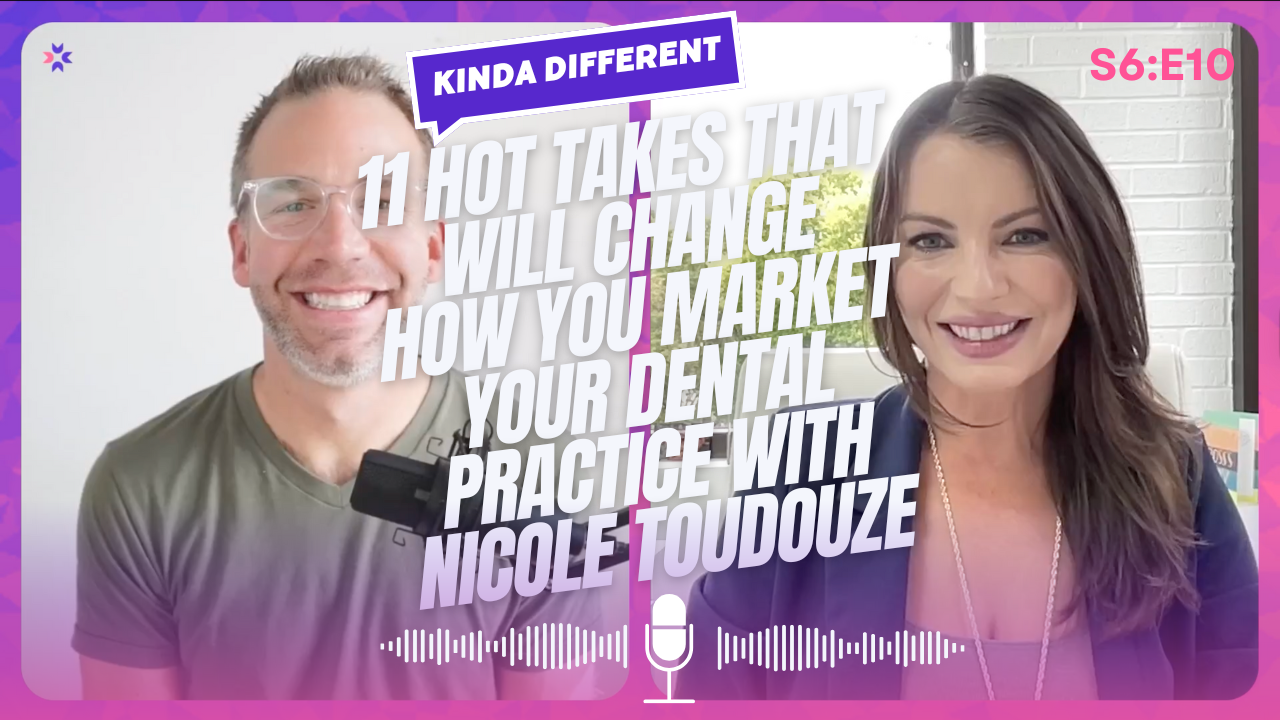
11 Dental Marketing Hot Takes with Nicole Toudouze
This episode explores the most common marketing mistakes dental practices make and what actually drives sustainable growth. Matt and Nicole break down how retention impacts revenue, why most practices struggle to articulate their value, how bad attribution wastes budget, and why patient experience and front desk performance are often bigger growth drivers than ads. They offer actionable steps for improving content, brand story, call handling, and measurement so practices can grow with clarity instead of noise.
Listen on Spotify, Apple Podcasts, watch below, or read the transcript at the bottom of the page.
Key Questions This Page Answers
• Why do many dental practices focus too much on new patients instead of retention?
• How can a practice clearly articulate what makes it different?
• What marketing channels matter most for real growth?
• Why are Google reviews not enough on their own?
• How should practices measure marketing ROI accurately?
• What role does front desk performance play in growth?
• How does patient experience influence marketing outcomes?
• Why can’t practices outspend operational problems?
Episode Snapshot
Host Matt Allen sits down with Nicole Toudouze, CEO and founder of Transcendental, for the Season 6 finale of Kinda Different. Together they unpack 11 hot takes about dental marketing, patient experience, and operations. Matt and Nicole discuss what actually drives growth, why many practices waste marketing dollars, and how small shifts in storytelling, measurement, and front desk performance can change everything. It’s fast, fun, and practical, with no fluff and no safe answers.
Key Topics Covered
• New patients vs. retention
• Articulating your value proposition
• Internal vs. external marketing
• Brand identity and differentiation
• Google reviews and local SEO
• Website content and patient-centered storytelling
• Video and authentic content creation
• Marketing attribution accuracy
• Social media strategy for practices
• Front desk scripting and empathy
• Patient experience as a growth engine
• Operational breakdowns that block ROI
Episode Highlights
• Why retention often matters more than acquisition
• How practices can define what makes them truly different
• Why websites should talk about the patient more than the doctor
• The limits of Google reviews when used without brand identity
• How custom photos and video outperform stock content
• Why manual attribution leads to bad decisions
• The small front-desk changes that increase appointment bookings
• Why patient experience is the most underused marketing tool
• The operational problems no amount of ad spend can fix
• One thing practices should try this month: offer an appointment on every call
Guest Bio
Nicole Toudouze is the CEO and founder of Transcendental, a strategic marketing agency focused exclusively on helping dental practices and DSOs grow. With more than 14 years in the dental industry, Nicole specializes in brand development, patient acquisition, attribution analytics, and building marketing systems that drive measurable revenue. Her approach blends storytelling, custom content, and data-driven strategy to help practices stand out in crowded markets.
FAQs
1. Why are new patients overrated compared to retention?
Because most practices lose more patients out the back door than they realize. Recare, missed appointment follow-up, and trust gaps create silent churn that no amount of new patient acquisition can cover.
2. Why do most dental practices struggle to articulate their value?
Many default to generic claims like comfort, convenience, or technology. Patients respond to specifics about experience, empathy, clinical focus areas, and how the practice addresses common fears and barriers.
3. Why is marketing without business goals just expensive noise?
External marketing is only effective when tied to a clear business problem, such as adding an associate or expanding hours. Without goals, practices overspend on channels that cannot solve operational issues.
4. Why do dental websites lose patients when they talk too much about the practice?
Patients want to see themselves in the story. Copy focused on the practice instead of patient needs, fears, and outcomes reduces trust and conversion.
5. Do Google reviews matter more than branding?
No. Reviews support the brand, but they cannot replace a clear identity and story. Strong brands create meaning; reviews reinforce it.
6. Why are Google reviews on the website a missed opportunity?
Patients already read Google reviews on Google. Website real estate should show differentiated proof, such as video testimonials, patient experience data, or authentic storytelling.
7. Why does manual attribution kill marketing ROI?
Patients rarely remember accurately how they found the practice. Self-reported “Google” or “Facebook” answers blur the results. Accurate ROI requires integrated tracking across touchpoints.
8. Is most dental social media noise?
Yes, when it relies on stock graphics or generic posts. Social only works when it uses real video, patient stories, behind-the-scenes content, and authentic brand voice.
9. Why does front desk performance matter more than nicer personalities?
The issue is usually scripting, training, and support. Empathy, tone, and offering an appointment on every call dramatically improve conversions.
10. How is patient experience a form of marketing?
Patient experience shapes reviews, referrals, retention, and trust. The way people feel in the practice directly influences growth.
11. Why can’t practices outspend bad operations?
Missed calls, poor scheduling, unclear processes, and lack of follow-through waste marketing dollars. No ad budget can overcome operational inefficiencies.
Transcript
Matt Allen (00:01)
What's up everyone. Welcome back to not just another episode of Kinda Different, the season finale of season six of Kinda Different. Yeah, yeah. I am Dr. Matt Allen, I'm the CEO and co-founder of DifferentKind and your host for Kinda Different. And on this podcast, we normally talk about things like innovation and dental care. We learned some amazing things about the people we chat with and we talk about how we can make dental care more human. I think we'll touch on some of those things today.
But today is a super special episode. have with me Nicole Toudouze, the founder of Rranscendental, your favorite, or if it's not your favorite, should be your favorite dental marketing agency down in San Antonio. And we have a very special episode today where we're just going to walk through some hot marketing takes, how they impact your practice, your group. And there's going to be no fluff, no safe answers.
just honesty about what's working, what's not working, what questions you might have. Nicole, thank you so much for joining us. I hope you're ready to make some people maybe not feel uncomfortable, but maybe like push the boundaries a little here. Thanks so much for joining us. Tell us a little bit about you, Transcendental, and then we're gonna dive in.
Nicole Toudouze (01:13)
Yeah, Matt, when it comes to making people uncomfortable, don't threaten me with a good time, right? I'm here for you. So I am ready to dive in. I'm so excited that we're finally doing this. You and I have been good partners for a while now. I just totally admire you and I'm thrilled to be here.
Matt Allen (01:17)
Ha ha ha.
Awesome. But yeah, tell us, tell us a little bit more just about you and transcendental, give us, give us a little bit of background.
Nicole Toudouze (01:32)
Yeah,
Absolutely. So I'm Nicole. I'm the CEO and founder of Transcendental. We are a full-service strategic marketing agency that specializes in building and growing dental practices. I've been in the dental space for about 14 years now. I love it. I'm never leaving. And yeah, I just absolutely, you know, I'm passionate about growing practices and helping practice owners and groups, you know, achieve their business objectives.
Matt Allen (02:00)
Awesome, well, that's a great place for us to start with our hot takes then. So I'm guessing that kind of in this first segment, we're gonna talk a little bit about why practices don't grow like they think they do or they think they should be. And so first hot take here that I'll give you to kind of respond to, I was thinking about this whole set, like all of these, and I was like, maybe we should do a draft. Like we have all 10 of them. We like draft which ones we think are the most important, but we're just gonna go through. I think it'll be fun this way too.
I didn't want to confuse too many different types of podcasts, you know? So first hot take here, new patients are overrated. The real problem is retention. What do you think?
Nicole Toudouze (02:33)
Yeah.
You know, I do think there's a retention problem. I don't think a lot of practices pay attention to what we call the leaky bucket or people walking out the back door, so to speak. So what that recare rate looks like, whether or not their team is following up with missed appointments, getting people back in the door, that, you know, sort of marketing funnel, right, from external to internal marketing is so important. When you have people that are loyal to the practice, they are more likely
to then refer, right? And that's where word of mouth comes in. So having patients that return, that are loyal, that leave reviews, that refer to other patients, that's how you can grow your practice organically. And so not paying attention to the people walking out the back door is a critical mistake that I see a lot of practices make. And then they want to throw money at marketing, not even paying attention to the fact that they're losing the patience they already have. And it's like,
If you're not fixing the problems internally, if you're not addressing the existing patient concerns, those new patients aren't going to end up turning profit for you when they come in the door because they're gonna end up leaving as well. So it's an important topic.
Matt Allen (03:41)
Totally. mean, I feel like, you know, there's so much focus on that, you know, 30 new practice to 30 new patients a month, 50 new patients, whatever it is, right? Like we see that all the time when practices are getting sold, all those different pieces, right? But no practices out there being like, you know, to like two patients leave us a month, right? Like what is your attrition? ⁓ and certainly, you know, I think that, it's, impossible to fill a leaky bucket, right? If you just keep having water flow out the bottom. so
Yeah, we'll talk more about that ops problem later and throwing money at, you know, problems and that, but I think that, you know, to me, this is one of those things where sure, it feels great to have a new patient, but especially as a clinician, right? Those are really hard appointments. It's hard to like meet somebody new show up and like be super present and, know, do all the things that you have to do in a new patient appointment that are different. and obviously there are pluses to that. And, if you have patients that trust, you know, you care about, right? You have that relationship.
Nicole Toudouze (04:30)
Mm-hmm. ⁓
Matt Allen (04:37)
You don't have to build that trust. It's already there. And oftentimes, you know, when we think about like, Hey, what is the, you what does that mean for their treatment? Right. They might still have a lot of treatment that needs to be done, especially over the course of time. Right.
Nicole Toudouze (04:46)
Mm-hmm.
Yeah.
Exactly. Yeah. I think, you know, that's a good perspective on the case acceptance component in terms of when you bring a new patient in, it's a lot of effort for very little value in the first year. And so being able to focus on building relationships and rapport with the patients that you do have and potentially getting more, you know, shared wallet and lift off those, you know, those existing patients.
Matt Allen (05:14)
Totally. Okay, so
I know you're passionate about this hot take, hot take number two here. Most practices cannot articulate why a patient should choose them. What do you think?
Nicole Toudouze (05:22)
Yeah,
yeah, you know, it's so interesting because anytime a new practice on boards with us, we do this onboarding survey where we really try to draw these answers out of them. It's like, what are your value props? What are your KSP? What makes you different? Why should people choose you instead of the practice next door? And they have the hardest time articulating it. They just leave it blank. And if they do say something, it's typically, we're comfortable, we're convenient. We have free parking.
things like that and it's like, that's not what appeals to the patients. And so being able to, like if you don't understand your value, the patient sure as hell isn't gonna understand your value. And so it's really important that you truly, and for me, this comes down, like this is like a trickle down effect, right? Like if I know what's important to me as an owner, my team is gonna feel that, my clients are gonna feel that, my partners are gonna feel that and.
you could go, right, talk to your clients about, this is why I recommend transdental, this is why I think they're the best, right? And so it's the same thing for dental practices. You have to be able to articulate to the community and to prospective patients on why you were the practice for them. beyond that, understanding who is your patient avatar so that not only is that pitch received, but it actually resonates with that prospective patient because it's...
It matches their need state and who they are as a person. Yeah.
Matt Allen (06:43)
Totally.
And we'll talk about that a little bit more in a minute. Uh, there's a little bit more in a minute, but I feel like one of the issues here is just the general inability for a lot of folks to get out of their own head, right? It's like actually put themselves in the shoes of the patient. We'll talk a little bit more about that, but you mentioned kind of this idea of defining your uniqueness and being able to like really think about that. Is there anything that you have folks do, or is there any way that you kind of go about that, that like helps people? Like if they're like, Hey,
Nicole Toudouze (07:05)
Thank
Matt Allen (07:11)
Yeah, I look at my website right now and it feels like, you know, I see like we use advanced technology. Well, like what practice doesn't at this point, right? Like, yeah, to your point, like free parking, who cares, right? Like that's five bucks on like a really large, you know, healthcare visit, right? Like no one really cares about that at the end of the day. So what is one kind of simple thing that folks could do to actually help them think about what does make them different or how they do stand out.
Nicole Toudouze (07:19)
Yes.
Nicole Toudouze (07:36)
I think this exercise is best approached when you really put yourself in the shoes of the patient and try to figure out what are some of the barriers that prevent them from wanting to see a dentist, any dentist, not just you. And what do you do to sort of accommodate some of those concerns, whether that be dental anxiety, dental fears, or just overall like people want to avoid the dentist at all costs.
So, what do you do to really address some of those things? And I think a lot of the things we see in our practices, like the noise canceling headphones, TV streaming so that they can distract themselves and show that they like really personalizing the appointment to be more of an experience for them versus an appointment, a clinical appointment, so that it feels more like a home environment. And so I think it really starts with the kind of experience that you're creating within the practice and really
end to end from the patient walking through the door to the time that they leave, what are the little fine details that you're putting in place that make them feel comfortable, welcome, and at ease? so, you whether that be music, noise canceling headphones, blankets, I see massage chairs now, all those sort of bells and whistles, know, practice owners don't necessarily want to invest in those things, but it really goes a long way in winning the patient over. So comfort in general, but don't just say we're comfortable.
Why are you comfortable, right? ⁓ Do you offer conscious sedation, IV sedation, things like that to help with anxiety? What do you do to address financial concerns? Because there is the stigma that dentistry is expensive and people are gonna assume that. And so being able to say right out the gate upfront when they're considering you, we have all these options, don't worry about it, we got you covered. And then things like.
Matt Allen (08:54)
Thank
Nicole Toudouze (09:18)
A lot of my practices on the first appointment, they'll spend like an hour in a new patient exam just to get to know the patient and personalize the treatment plan. And I think that's a value prop. Also flexible hours and things like that. And yes, credentials matter, but really kind of focusing in on what your expertise is, right?
Matt Allen (09:23)
Mm-hmm. Yep.
Nicole Toudouze (09:40)
Transcendental's expertise is growing practices, new patient acquisition, and branding. A dental practice, you can hang your hat on, maybe you're minimally invasive, right? Maybe you're holistic. Maybe you can hang your hat on being highly aesthetic and cosmetic. Maybe you can hang your hat on changing lives with smile makeovers. Maybe you can hang your hat on being a diamond provider of Invisalign, right? There are...
Matt Allen (09:49)
Yep. Yep.
Nicole Toudouze (10:03)
sort of, know, sort of kind of claims to fame that you can position yourself in the market so everybody knows that you're the go-to person for that particular procedure.
Matt Allen (10:13)
Yeah, totally. I love all of that. I think one of the things that I would often start appointments with when I was practicing was, you know, Hey, this might feel a little different today and here's why. Right. And so I would kind of like call it out, right. I've like, here's what we're going to do. And a lot of that for me was like, Hey, we're going to spend time talking about your goals and, kind of spending more time with the patient, right. Like really thinking about that and, kind of, but
To your point of, you know, what, what are the things that people typically, whether that's anxiety, whether that's wait time, whether that's whatever it might be financial concerns, what are the things that go with the typical bad dental experience, right? Or that the experience that they might have and how might you be creating different points along the experience to say, Hey, this feels different. that when a patient's like, you know, I couldn't even articulate that, but it was just way better, right? Because it was like, wow, maybe they had, you know, some kind of like weight system, you know, like age is not waiting is better.
But like, if you do have to wait, like, Hey, this provider is running on time. You're going to be back in your chair. You're not going to wait an hour, you know, whatever it might be. And so I think that that, you know, is something that can really help, um, people articulate like why and how they're different, you know, when, when it's like, what are those typical things that people typically associate with bad dental experiences are just kind of crummy or run of the mill dental experiences. And how can you be better than those things?
Nicole Toudouze (11:14)
You're not.
one of the things we do too, when a provider or an owner or, you know, like a regional manager, if it's a group or whatever, when they can't articulate what makes the dentistry different, we'll go read the Google reviews so we can understand from the patient perspective what they think. And patients love, and I interview patients all the time for our videos too, so I get a lot of perspective from there.
Patients love when they go into an operatory and it's like welcome Nicole on the screen. A lot of the feedback I get in these interviews is I don't feel like a number here. My name, they stand up and they smile at me when I walk in the door. They say my name, they welcome me when I get into the chair. They know the kind of music I like. They have my show on. It says my name, it welcomes me. And all that happens before you even get chair side.
Matt Allen (11:58)
Yeah, yeah.
Mm-hmm.
Nicole Toudouze (12:22)
you'd have to like really screw it up to go south at that point. Just by setting that preface of like, we truly, truly see you care and want you here and we you're not just any other patient, right? We want you in our practice. So going that extra mile to humanize, know, which is a lot of what you do humanized dentistry and humanize the experience and make them feel seen and valued. It's really kind of what it comes down to.
Matt Allen (12:26)
Yeah
Totally love it. All right, hot take number three, marketing without business goals is just expensive noise.
Nicole Toudouze (12:56)
Yeah, people love to market without understanding why they're doing it. I love to hold that conversation. like, you know, when we talk about
Matt Allen (13:00)
you
I feel like
this is just like people not understanding marketing in general, right? So maybe you could like help us understand that too. But like, yeah, I totally agree with you, obviously.
Nicole Toudouze (13:10)
yeah.
Marketing is one solution that you can reach for when you have challenges or problems or goals in your business, right? But it's not always the answer. So we started this by talking about re-care and leaky buckets and all of that. And it's like, marketing's not gonna fix that for you, right? So marketing isn't always the answer. So it's first really important to make sure that marketing is even the solution to the problem you're trying to solve or what it is you're trying to achieve.
Matt Allen (13:40)
And to be clear, you're talking about external marketing here now at this point, like reaching outside. Cause I think a lot of what we were just talking about is kind of internal marketing, right? ⁓ But then we're talking about external marketing.
Nicole Toudouze (13:50)
Yeah, so if you're deciding to do some patient acquisition, for example, making sure that external marketing is the solution for whatever it is you're trying to achieve. And I think a lot of people, you know, when they come to me, I'll be like, okay, why are you reaching out? And they don't really understand why other than they feel like maybe they're supposed to, right? Or like revenues down or whatever, but.
you know, like we were just discussing, that could be any other issue. It could be attrition, could be churn, could be a lot of maybe case presentation, you know, it could be a lot of different issues going on within the practice that marketing may not be the right solution. So I think the first step is really truly understanding what the problems are and whether or not marketing is the actual, you know, productive solution for that. And then say you determine it is
I think some of the milestones I typically coach on what are triggers for an external marketing program, going to be adding an associate, expanding hours, adding a location, starting a new practice, getting a new piece of technology, rolling out a new procedure.
Matt Allen (14:48)
Mm. Mm.
Nicole Toudouze (14:54)
It could be equipping more ops like there's a lot of different triggers for that or maybe you just want to grow right ⁓ so It just depends but the marketing strategy Should look different for every single one of those things I mentioned and that's where people really get lost because they're like, alright
You know, like they think when you see in these dental groups and you see people posting, do Google ads work for you? Does direct mail work for you? Does social media work for you? Am I doing this right? It's like, but your problem could be very, very different from everyone who just answered on your post and.
what worked for them may not solve your specific problem. And so being able to say, here's the problem I'm trying to solve, or here's what I'm trying to achieve, and then leaving it to an expert, whether that's me or my team or another team, but leaving it to the experts to be able to say, you know what, for this problem, this is typically the best solution, data backed, right? So I think that's an exercise a lot of people just skip over.
Matt Allen (15:51)
Yeah.
Nicole Toudouze (15:52)
of
that and that's really the marketing development plan that I preach about and I have since the day I got in this industry is like develop your marketing plan you don't just flip a switch and put on some ads you got to really be intentional with it to to see the fruits of that labor
Matt Allen (16:06)
Otherwise it is just expensive noise, right? ⁓ Spending a lot of money and you're like, look at my ad. Look at that billboard. It looks nice, but it might not be meeting any of the needs in the way that you need to. All right, hot take number four, last one of this section. I love this one. I have very strong opinions on this one. If your website talks more about you than your patients, you're losing.
Nicole Toudouze (16:08)
to six points and minus the extent of the arm.
Exactly.
Okay, do you want to start on this one since it's your question?
Matt Allen (16:36)
Sure. mean, so here's, think the issue that I generally have with, you know, it's like, yeah, it's just like us, us, here's us, here's us, here's us. And whenever we think about being, you know, going to any place, we want to feel understood, right? Like that's why listening works so well in an office or in any setting, right? Is because like you want to be understood. That's a typical human desire. And so sure, like we need to be able to say,
you know, here's what we do and here's how we do it. But when it's just a long list of procedures, right? Of like things we can do, it's like, well, you know, we don't, we don't even know if the patient wants or needs any of those things. And so, you know, how do you kind of get ahead of that and think of yourself again, more like we talked about earlier, being really empathetic, right? Like you might have this problem. Great. Like, you know, it's, it's, mean, I think honestly, a lot of this comes from the fact that in dentistry, like we don't even have diagnosis codes.
You know, and that's just like, it's not the, it's not the reason that this happens, but it's certainly like a symptom of it is that we're just like, all right, cool cavity. I'm going to fix it with this thing instead of like, what is the diagnosis? What is the thing you have so that I can do the thing that I can do. Right. And we just move on immediately to the thing I can do instead of thinking about what that is. And so, yeah, in general, I think that, you know, this is one of those things where the more that we can put ourselves in the shoes of the patient and kind of talk about them.
Nicole Toudouze (17:38)
or treatment.
Matt Allen (17:57)
Then we're gonna set ourselves up differently to be perceived by the patient in a better way, right? Of like, not even from the moment they walk in the office, but from the moment we go to their website, we feel like this is different.
Nicole Toudouze (18:09)
Yeah, and I think this is really what makes the argument in terms of content on the website stock versus custom Storytelling brand storytelling and that's what you know We really advocate for here is like I always get so sad when nobody has assets or they won't hire us to do their media Because I just know they're shooting themselves in the foot tremendously, especially dental groups, you know because it gives much turnover on Associates and and they don't want to invest in that stuff not realizing
Matt Allen (18:17)
Mm.
Nicole Toudouze (18:39)
you know, they really would.
tremendously benefit from it when it comes to conversion rate optimization on the website. And so when a patient is going to a website, one of the things we really like to do is have patient testimonials on the homepage, patient interviews, so that they can say, that's my problem. ⁓ I can see myself as this person. I can see myself here in this practice. And even with the photography, we don't just do headshots and team photos and photos of the office. We do, we document the patient experience start to finish photography so that
Matt Allen (18:51)
Mm-hmm.
Nicole Toudouze (19:09)
we can display so they don't even have to wonder what is that experience gonna be like. They can just go through the website and envision it themselves and put themselves in there and go, yeah, this is where I wanna be. So I think that really pertains to the content that you feature on your website and telling a story so that they, again, can see themselves within the practice.
Matt Allen (19:29)
Totally love it.
Great. Okay. Let's keep going. Second, second part, we're to talk about some hot takes here that are kind of related to marketing channels that actually work and ones that maybe don't and kind of drain your budget and some of those things. So we've already talked a little bit about Google reviews, but hot take here. And I don't actually know how much I agree with this. I agree with in some ways. I don't agree with them in other ways, but hot take number five here, Google reviews matter more than your really expensive rebrand.
Nicole Toudouze (19:39)
Okay? Okay.
No, don't agree with that necessarily. ⁓ Well, if you have great Google reviews and a weak brand, that's again, a waste of money, like a waste, it doesn't matter. They need something, they need the affinity. They have to have something to attach the reputation to. The reputation has to be born of an identity. If the identity is lacking or non-existent, the reputation is also non-existent. That's just words on a page.
Matt Allen (19:57)
Great. Tell me why.
Yep.
Nicole Toudouze (20:21)
So it has to be supported with a really strong brand foundation. You me coming from branding and advertising with really big brands, I am a huge proponent of branding and having a strong identity in storytelling. so like being able to say, we're this and that. And then for the consumer or the patient being able to go online and say, yes, you are because people verified that.
That's just supplemental to what you're to your own voice. So yeah, that's my.
Matt Allen (20:47)
Yeah. So it feels
like this is one of those, it's like not an either or, right? It's like, you shouldn't have necessarily one or the other. ⁓ but it's, know, like, I think it's one of those things where there's so much focus on Google reviews for so many people, right? Whereas it's like, just like drive, drive, you know, drive new patients, right? And then again, I think that comes back to just that like drive new patients. Like we just got it. And so like people end up just chasing Google reviews, right? And that obviously is not built on any sort of.
Nicole Toudouze (20:55)
Yes.
Yes.
Matt Allen (21:16)
foundation, right? Of like, what is the brand promise and who are we? And like, what are you going to feel when you come into this office and all of that stuff? Right? Like it's really hard to get those. So it's like, you know, it's not, it's not either or it's a yes. And right. Like you need to have that foundation of who you are and what that means. And whether you spend a lot on that or a little bit on that. Right. And then yes, like Google reviews are a part of like driving local SEO and like potentially helping new patients find you when they're looking for you online. But like you can't do one without the other necessarily. or you can't just like do one really well and one really bad and
Nicole Toudouze (21:21)
Yeah.
Matt Allen (21:45)
hope it's gonna work out.
Nicole Toudouze (21:46)
Yeah, and I think the reviews are an echo of your own voice, right? Whenever, like, when everyone thinks of a brand, they think of a logo, and I always love to this quote, one my favorite quotes about branding, I can't remember who says it, so hopefully I don't get sued for copyright infringement or something.
Matt Allen (22:04)
Sorry. I don't think anyone's gonna copy. You anyone's gonna sue us for that. So you say whatever you want.
Nicole Toudouze (22:07)
One
of my favorite quotes is, a brand is the sum of all experiences you have within.
Matt Allen (22:14)
Mm-hmm.
Nicole Toudouze (22:15)
So it's
the person who answers the phone, it's the website, it's the doctor and what their chair-side manner is like, it's the smell, it's the sounds, it's the lights, it's all of it. And the reviews are just echoing the experience. And so if the brand is lacking and the experience is lacking, well, the reviews don't have a leg to stand on.
Matt Allen (22:36)
Yeah, totally. Cool. All
right, we're gonna stay on Google reviews for number six. You ready? Again, this is one of my faves. I have a strong opinion about this. Google reviews on your website are a missed opportunity. Tell a better story. I'll start here because again, this is one of the things that I'm super passionate about. So I've used, we see this all the time, right? If Google reviews are a way to drive local SEO, right?
Nicole Toudouze (22:41)
Ready?
Okay.
Matt Allen (23:01)
So patients go and search like, Dennis in San Antonio, right near me or whatever they're searching to find you. And then you come up and it's like, they're probably going to read the Google reviews on Google, right. Or wherever they're searching. And then they go to your website and it's just like, here's some of the Google reviews that you just read. that's not building more trust, right? That's just like showing the same information and people get really disinterested when it's the same information. And so, you know, obviously like this is where I think.
we see hospitals do this a lot of times, right? Where because they are collecting different patient experience data than just using Google reviews, they can actually put on their website information that is very differentiated from how patients might've found them. So it might be like, they listened to my, you know, like a star rating on, they listened to my concerns or they like explained things to me in a way I could understand or whatever, right? Like go on the Cleveland Clinic website, check it out. It's very like obvious how they do this and they talk about why they actually have that data and why they show that.
And so to me, this just feels like one of those opportunities for dental practices where it's like, Hey, don't just go show the same things that you already had. because again, it's just, it's duplicate information and people are looking for continue. You can continue to build trust if you do something different on your website, go ahead and respond to that.
Nicole Toudouze (24:14)
Yeah, and I think that's really where video can do a lot of the heavy lifting. So it's like, maybe we're kind of approaching the same market positioning, but we're doing it in a more personalized way. Instead of just Google text, now we're engaging with these videos and this storytelling. So I always am going to prefer video testimonials over Google reviews on a website any day of the week.
You know, also I think it's an opportunity to say, here's how many smiles we've transformed. Here's how many lives we've changed, right? Instead of just regurgitating someone else's words in your own voice, you know, really be confident in saying, here's how we make an impact.
Matt Allen (24:54)
Yeah,
totally. It just feels like there's a great differentiation opportunity here that just so many practices are missing. And, you know, this is one of those ones where it's like, yeah, if you're, if you're, you know, working with transcendental, like you're thinking about this differently, right? Like a different kind, we're thinking about this differently. Like it's not just like do more of the same chase to Google reviews, right? Like there are better and different ways to essentially use your website as, you know, the prime differentiation opportunity once people have already gotten there, right?
Nicole Toudouze (25:01)
Yes.
Yep.
Matt Allen (25:24)
All right, cool. Hot take number seven. We're crushing. We're like really clipping along here. I love this. This is fun. I know that you care about this one as well, a decent amount here. You can't grow what you don't measure. Manual attribution is killing your ROI. What do you think?
Nicole Toudouze (25:37)
My temperature just went up on this one. ⁓
Matt Allen (25:39)
You're like, I'm angry.
Yes. Let me dig in.
Nicole Toudouze (25:44)
Matt, these people... See? Not a good way to start a sentence. Okay.
Matt Allen (25:49)
You're already angry. Yes, here we go. Calm.
This is podcast about loving people and taking care of it.
Nicole Toudouze (25:54)
It's cancelled.
Okay, help me help you people, all right? Don't ask your patients how they heard about you. They don't know. If Susan Nextdoor told them, then they went to Google and looked at the reviews. When they come in, there's a 50-50 on if they say Susan or Google. If you serve them an ad campaign on Meta,
paid ad, and you ask them where they heard about you and they say Facebook. You don't know if that cost per acquisition was organic or paid. And there's a very big variance in the cost per acquisition on a social media post and a paid campaign. Okay? If they come in and they say they heard about you from Google, I can give you five different touch points on Google that could have been the attribution.
Google is the world. Like saying, you know, I don't know, what kind of car do you drive? Truck. You know, like is it a Ford? Chevy? it, you know, like so sorry, I'm so passionate. I'm really on my soapbox. I tend to do this. You said you wanted to keep all uncomfortable. I'm calling you out.
Matt Allen (26:58)
It's big.
I love it, I love
it. Your passion is coming through, it's great. It's great, keep going, keep going, let's go.
Nicole Toudouze (27:18)
⁓
Stop basing your business decisions. Like your patients don't know. And not only that, I am a busy single mom of three. I've run this company. I got a lot on my plate, okay? I don't care as much as you care about that answer. And I'm not giving it much mental thought. So a lot of the time when I'm going through the new patient paperwork, I'm like checking random stuff.
You know the medical history part? I just, I'm the one that does the line from top to bottom and no, I'm not reading it, sorry. I won't sue you if something goes wrong. Right? They wanna get through that paperwork. They don't care, man. If they're self-sourcing, it's not valuable information. I'm sorry, it's not, it's not.
Matt Allen (27:54)
healthy, just write healthy, huge letter.
Totally. So
then what, like, how do high performing teams do this? Like when they move to actually track the source of the track, like the actual real source of attribution and what do they learn? what are, obviously this is deeply, you're deeply passionate about that. Give us, give us answers to those.
Nicole Toudouze (28:19)
passionate
that I built a solution.
Matt Allen (28:24)
Great! Those
are the best solutions when it's like you feel the problem so deeply,
Nicole Toudouze (28:28)
Yeah, so we now utilize a platform that integrates with every PMS and does feedback loop, pass through data. So the API then feeds us back the data on, know, if Joe Smith comes into the practice, we know first touch, second touch, third touch, what campaign, what he searched, how he scheduled by phone or web. know...
When he's scheduled, know after the initial exam, we know like if he came in on an offer, we know that. After the initial exam, what does the treatment plan look like? What's projected collections for the patient life cycle or treatment plan? And then we track it all the way through actualized. And so, but it's funny because my clients all know I have this and like we do this and they still are like, well, everybody says they're coming from Google. I'm like, do they say that? And then I like pop the dashboard and I'm like, why are you still telling me what they're saying?
Matt Allen (29:12)
Thank
Nicole Toudouze (29:17)
It's here. Science. Technology.
Matt Allen (29:21)
Ask a better question, right? And it is one of those things where it's like, you only have so much time, right? And so it's like, if you're doing it really well, right? Just let that go, let that die by the wayside of like, how did you find out about us? We already know that, and now we can actually move to like, how can we help you? How can we serve you? How can we care for you, right? Those are much better questions to talk about than how did you find us, So, okay. How's your blood pressure doing? You okay?
Nicole Toudouze (29:44)
Yep. Yeah. All right.
Matt Allen (29:49)
You
Nicole Toudouze (29:50)
I think I'm okay.
Matt Allen (29:52)
All right, cool. We got one more question in this section. Maybe we'll, this one is not quite as hot button maybe for you. So hot take number eight here. Most dental social media is noise, but a tiny bit of it can actually drive growth and might be important. Agree, disagree? Is it noise? Is it not? What you think?
Nicole Toudouze (30:08)
I think it's another, yes, I mean, you can definitely drive growth through social media. It's not going to be the same volume as a paid campaign or SEO, for example, which is a primary driver. It will drive. I think it depends how it's done. It has to be done well. I'll tell you all the reasons why I think social media is important. One, it impacts SEO heavily. People wants to see you active on Instagram and Facebook at least three times a week.
Matt Allen (30:29)
Mm-hmm.
Nicole Toudouze (30:34)
on your platforms. Two, again, online reputation. Some people go to Google reviews, some people go to the website, and some people go to Instagram. So it just depends on the audience, the patient avatar and your brand. And then the content, you the success of social media is heavily dependent on the content. I see so many people like paying these marketing vendors like, you know, $1,000 a month to post canned graphics and it's like...
Matt Allen (30:59)
you
Nicole Toudouze (31:01)
My six-year-old could do that in Canva, you know? It's like, need to be generating content through video reels, patient testimonials, showcasing technology, showcasing expertise, sharing the patient experience, the patient sentiments, really telling the story. so, so that when people, it's the same thing if I go to a website and it's all stock.
And it's, I'm comfortable, I'm convenient, and here are some Google reviews and it's all stock. I'm bouncing. You're not for me. Right. I want the human experience. I want the personal experience. It's the same thing if I go to an Instagram page, right. And it's just every other one is a regurgitated Google review or,
Matt Allen (31:29)
Yeah, go.
Nicole Toudouze (31:40)
you know, a photo of the cheesy smiley smiling like Macy's family. It's like, what is how does it matter to me? I don't know. ⁓ And so it's all about the content you're putting out and having a strategy behind it. Right. And so a lot of what we do is like, for instance, one of our dental groups was like, we really want to do a very fall sort of heavy brand. And it turned out so beautiful and it's so engaging. And it was just it
Matt Allen (31:47)
Yep. Yeah.
Nicole Toudouze (32:08)
helped it stand out in a way that I think would have spoken to that audience. And so we really have those dialogues where we're like, tell us what's going on in the practice. We're not gonna pretend to know. I need to know what's important to you right now so that I can make that manifest externally.
Matt Allen (32:23)
Yeah, yeah.
Totally. Yep.
Yeah. To me, it feels like another opportunity to build trust, right? It feels like another opportunity for people to understand your voice, right? Certainly, you know, to your point, right? Like you're like, Hey, this is, you know, I see this and it's not for me, right? Like if I, you know, I personally hate the like dancing dental tick tock like crap, you know, like I'm just like, if I see, if I saw that I'd be like, I'm not going to go to that practice. I just, that's not for me, right? Like, and it might be for somebody else, but it's not for me. Right? So it's like, you really do have to think about like what kind of, you know,
Nicole Toudouze (32:47)
the only thing felt that way.
Matt Allen (32:55)
how people are gonna perceive that and like, how does that build trust with the kind of patient that you want to have in your practice, right? So, ⁓ yeah. Great.
Nicole Toudouze (32:55)
Yes.
⁓ I want to add to this hot take because I have a personal hot take about this. It's like
the when practices post the reels that are satirical that make fun of their patients Like wait, I'm sorry again making people uncomfortable. I'm gonna offend you I'm all about alignment. So if you don't like what I'm saying, I'm just not for you. I don't know ⁓
Matt Allen (33:12)
Hmm.
Yeah, there you go.
Nicole Toudouze (33:22)
But these practices that do videos of like, yay, last patient of the day canceled. You're sending the message to your patients that you don't want to see them. Not funny to the patient. It's funny to all your demo friends that you graduated university with. It's funny to your team. I don't find it funny.
Matt Allen (33:32)
Totally.
Right.
Yeah. Yeah. It's like really tone deaf, you know, in those ways, right? It's again, not putting yourself in the shoes of the patient, which, you know, anything that we are putting out there should at least take that into consideration. And if not strongly take that into consideration, right? so yeah, a hundred percent agree. Love that hot take on top of a hot take hot take inside of a hot take. it's like a double decker taco from Taco Bell right there. There you go. It is. love it.
Nicole Toudouze (33:57)
you
That's exclusive.
Matt Allen (34:08)
All right, last section where marketing breaks down. We're going to have a few hot takes here. We got a bonus hot take because we can only have 10. So we got a bonus hot take. All right, but let's let's go into this. I know you I know you care deeply about this one as well. Your front desk doesn't need nicer people. They need scripting, training and support. Tell us.
Nicole Toudouze (34:26)
I think that if most owners and stakeholders, if we're talking about like a dental group, if they heard just one day of phone calls, their skin would be crawling.
Matt Allen (34:36)
you
Nicole Toudouze (34:38)
Most practices do not follow any best practices, any methodology, any scripting. They completely lack empathy. Like one of the biggest triggers for me is when I'm listening to a call and it's an emergency call or it's a parent with a child, something happened and they call. I'm in so much pain. I don't know what to do. Please. I need help. Okay. Let me see what we have. Like where is the, my gosh, I'm so sorry to hear that. We'll get you in as quickly as possible. We're here for you. Where is that?
Matt Allen (34:50)
Mm.
Yeah.
Yeah.
Nicole Toudouze (35:07)
Because to me, that's innate. Like, as a human, I'm innately wired to respond that way. I don't need to be trained, but to other people, maybe not. And so you have to account for that with scripting.
So we have scripts for every patient scenario, emergencies, cosmetic, price shoppers, insurance barriers, membership plan questions, you name it, we have it. And I provide it to most of my clients. And we also do complimentary call conversion consulting. I do it personally because I am so controlling over this process.
Matt Allen (35:39)
Like not letting anyone else do that. That's me.
Nicole Toudouze (35:42)
But can I please teach Sissy how to be nice, please?
Matt Allen (35:45)
Yeah.
It's it is like probably one of the, you know, it's like if you can change that, like you can change everything about a practice, right? It's like it does feel like the gateway, right? Obviously in so many ways. So.
Nicole Toudouze (35:56)
To me, it's the make or break. It's literally the end all be all of your business is your people and your people are the first brand impression. So do they embody what you want them to embody? And when I hire people, one of my questions is, do you give a damn? I only hire people with the give a damn factor, so do you?
Matt Allen (36:17)
You
Nicole Toudouze (36:23)
You know, and being able to, when you, and I know it's way different, I think, on the clinical side right now in terms of human resources. I'm so sorry. It's like, it's bad. And there's, it's slim pickings out there. It's really competitive. So I get that, right? Like you're just trying to get people in the roles, but just be really intentional with your hiring. Think about the personal values you want those people to embody if empathy is one of them. Think of some interview questions around empathy in the interview.
Filter people that way and then once you get them in give them what they need to succeed You don't just put them at the front desk and say alright when this rings pick it up Because you wouldn't believe the amount of people that I hear hello Can you imagine if you called a business institution and they answered hello? I'm sorry is this and you'll hear is this such-and-such to law office? Are they having to ask?
Matt Allen (37:10)
Yeah, like, wait, did I call the right number? what is it?
Yeah, I shouldn't have to be asking, right?
It is, it is really shy, know, so yeah, like that, you know, that level, you know, I think that because so many owners, right, like have been clinicians and you whatever, throughout the course of history, like it's just one of those things. It's like, this is how we've always done it. We don't know that realm. So we don't think about it. You know, you're like, I just need someone to answer the phone. But you're like, no, I actually really need someone up there to like be the best and most effective communicator in your practice. Right. And you're not giving him any tools and that obviously just doesn't.
Nicole Toudouze (37:45)
Yep. I walked out of a practice once, not a dental practice, a different kind of medical practice, but I went in there with a new patient. And to be fair, as someone who specializes in patient experience, my standards are kind of unattainable. you are a patient. But I walk in first appointment and she's like, did you do your paperwork? I said, yes. And she opens it and she goes, 30 minutes ago.
Matt Allen (38:01)
Very high, yes, that's all right.
Nicole Toudouze (38:11)
Real judgy. ⁓
First of all, I don't have a lot of time on my hands. I'm doing my best, okay? Empathize with me, I'm doing my best. And I was just like, I don't like the way this feels, and I left. Yeah, you know? And it's like, there will be people who won't put up with that condescending tone. And so, you you have to train your front lines, like, to cater to the patients and show compassion and be kind and create a positive experience because that ultimately is what reflects back on the brand.
Matt Allen (38:16)
Yeah.
That's awesome. Love it.
Yeah, totally. Well, you just led us perfectly into hot take number 10, which is your patient experience is your marketing. You're just not measuring it. Agree, disagree. Obviously, I think you're probably going to agree here. give me I have to care deeply about this one, too. But you you you you share first here.
Nicole Toudouze (38:48)
Yep.
Yeah,
I strongly agree on that one. Give people something positive to say about you and
Again, I think one of the tones of this podcast has really been patient perspective, being able to see beyond your own perspective, see outside yourself. What is attracting patients to you? What do they value about your practice? And really understanding that in a way that you can craft a story around that that will attract more patients. But to do that, you have to care what they think and who they are. Yeah.
Matt Allen (39:29)
Yep. Yeah. And I think it's one of those things like, because some of these concepts like tend to be or have felt amorphous in some ways, right, for people over the course of time, it's like, how do you measure experience? How do you measure trust? Right? Like, those are really great questions. And I think a lot of people like historically have just been like, well, we can't do it, you know? And so it's like, then it's just anecdotal. And you're like, well, that's not good enough. Like we actually have really good ways that we can do that. Right. ⁓ And that's where different kind can help, right, in terms of measuring patient experience.
That's where different kind can help in terms of measuring patient trust, right? Like we have a tool that measures employee trust, right? as well so that you can actually keep those employees that are, know, in your practice or in your group. And so I think because they tend to kind of feel like big, big, you know, kind of concepts, essentially people are like, well, I can't measure that. Right. And you're like, no, you actually can't, or you can at least get it. You can try. Right. And you're going to get something that's much better than just like, well, anecdotally, it feels like this. And you're like, well, that's generally.
not good enough, right? And to your point, then you can take that and actually put it in patient, know, like testimonials, you can put it in videos, you can use it on the website, you can use it in like, hey, we actually understand where the gaps are. Now we can close those things, right? Like you just all of a sudden tend to get a much broader picture than just like, well, I think it's this and you might be close, but you might be very, very wrong.
Nicole Toudouze (40:46)
Let me ask you something. I personally have experienced this. Do you see a correlation between owner being open to feedback and advertising that because somebody gets a negative review. It's like, but Nicole, here's what really happened. And I'm like,
Matt Allen (40:53)
Hmm.
They
were so crazy and they were, you know, just that patient just was wild, you know?
Nicole Toudouze (41:08)
Yeah. And it's like, okay, maybe not every time. You can't be right every time. ⁓ And I've heard Susie on the phone. Okay. You know, yeah, you can't be right every time, right? But beyond that, say you are a perfect human being.
Matt Allen (41:12)
Totally. Yep.
We understand.
Nicole Toudouze (41:25)
And it still matters what they think that's still their experience and other people could have that experience. There's still a learning to take from it, right? I don't always agree with every client who comes to me with negative feedback or shares an experience they feel is negative. I don't always agree with it. I will always receive it. I will always hold space for it. I will always acknowledge my accountability or the team's accountability. Typically as the owner, I take the
Matt Allen (41:29)
Totally. ⁓
Nicole Toudouze (41:55)
accountability but in when things happen because I want to grow and I want to learn and I think a willingness to grow and get better and be self-aware and let the ego go let the ego go just because you're in business or you're an owner doesn't mean you need to have ego let it go open the mind open the heart receive the message you don't have to agree with it but you do have to receive it that's how you get better
Matt Allen (42:21)
Yep. I, yeah. my gosh. Yeah. With another hot take inside a hot take here, but I see so many people just will like wanting, like literally asking to put their head in the sand. Like I don't want to see it. I don't ever want to know it. Right. I'm putting my head in the sand and you're like, well, okay, cool. Like that's fine. You know, like we're pro to your point of, Hey, that, you know, there, there's, know, kind of selectivity that happens of like you choose me. I choose you. Right. Like there's just like, well, there's just going to be those people and that's what they're going to do. And okay. Like, you know, so yeah.
Totally. All right, you ready for the last one? Bonus hot take number 11. We talked a little bit about this a little bit before, but I think it's a good one to close on. You can't outspend bad ops. You can't out add that, you know, that. If you have bad ops, you can't just like spend more money on ads and overcome the problem. Tell me what you think about that.
Nicole Toudouze (42:53)
Yes.
Yep, missed call rates are still so bad. I've been talking about missed call rates for 15 years now. Nobody's listening to me.
Ms. Coleray.
Matt Allen (43:22)
If we just listened to Nicole Moore, we would all be a lot better, right? Come on.
Nicole Toudouze (43:27)
Yeah, so I would say missed call rates are a big thing.
And I feel like there was a question I wanted to utilize this soundbite for, but I'm just going to say it now, which is when a patient calls, every single phone call should result in an appointment being offered. I don't care what the conflict is. And probably 10 % of calls answered, appointments are offered on a good day.
Matt Allen (43:45)
Yeah.
Yeah.
Nicole Toudouze (43:52)
That simple, teach them to offer the appointment. Well, I wanna verify my, I wanna talk to my insurance first. Well, okay, well, just call us back. They're not gonna call back. Let's go ahead and reserve this appointment time for you, because we book up pretty quickly, and I wanna make sure you get the time that's most convenient for you. And then once you're done talking to your insurance or talking, my gosh, don't you love when the husbands are like, hold on, I gotta talk to my wife. I gotta talk to her, I gotta make sure.
Matt Allen (44:21)
80 % of healthcare decisions in the families are made by by women, right? So you know, whether that's good, bad or indifferent, right? That is the stat. So it is crazy. ⁓ But it is true.
Nicole Toudouze (44:30)
Yeah.
Yep. Yep. But not just accepting that, right? Like being able, hearing it, I'm not saying like being argumentative with them, but still offer you appointment. Hey, we can get you on a schedule if we need to move it, no problem. But once they have skin in the game, subconsciously, they're committed. If you let them off the phone without me skinning the game, they're never calling you back. I guarantee you. Yes.
Matt Allen (44:38)
Yeah, yeah, yeah. Right.
Yeah. Totally. Yeah. Or, you
know, something comes up and, know, they just like other stuff, life happens, right? And all of sudden you're like, okay, cool. You know, like it just goes away for maybe, maybe they call you back in a year, but that's still like missed opportunity, right? Totally. all right. Cool. okay. So we've got, we've gone through a lot. That's a lot of hot takes, give us kind of one marketing hill. You'll die on one thing that you're like, absolutely. This has to happen every time, you know, whatever.
One thing that you feel like, yes.
Nicole Toudouze (45:22)
I'm going to give you two, custom content, so not using stock, and tracking and analytics, and not letting the patients all source.
Matt Allen (45:23)
Okay.
Perfect, I love it. And what's one thing that dental teams should stop doing this week? Something they can stop doing tomorrow.
Nicole Toudouze (45:33)
Thank
⁓ sending them to other practices. I hear that all the time. ⁓ we're full for the next two weeks. We can't get you in. You should try calling. What? You know what I would do if I heard my team do that? Like, what?
Matt Allen (45:48)
Yeah, that's not a
You'll lose your mind. Your blood
pressure would go up. We saw it. It was on question seven, I think, right?
Nicole Toudouze (45:57)
Let me put you on our cancellation list. Let me, you know, I mean, anything else, literally.
Matt Allen (46:01)
Yep.
All right. One more question for you. I'm a big believer in, you know, testing things, getting incrementally better, right? So experimentation, right? Like try things, try small things, try it once, right? What's one thing that you think teams should try in the next month?
Nicole Toudouze (46:18)
offering the appointment on every call. Watch the appointments go up without having to pay me any money.
Matt Allen (46:20)
Love it.
Love it. Great. Okay.
Cool. All right. So we've heard a lot about you and Transcendental and how you can help folks, right? And obviously you have a ton of expertise. If people need this kind of help, how do they reach out to you? How do they get in touch? Tell us a little bit more.
Nicole Toudouze (46:41)
Definitely you can visit us transcendentalagency.com and submit a form for a strategy session. You'll get a one-on-one with moi. And we'll go over all the things about your market. We'll look at demographics. We will do a full online audit of your practice and then come up with recommendations and kind of go from there. You can also follow us on Instagram and Facebook at transcendentalagency. We share so much valuable content on our social pages.
LinkedIn as well. Just free advice. It'll help you day one. So make sure to follow us. That's pretty much it. You cannot have my cell phone number. I said they cannot have my cell phone number.
Matt Allen (47:18)
Love it. What?
Some people do give their cell phone, know, so I like you. So we got to know where to go. Yeah, exactly. I love it. Well, since this is the final episode of season six of, uh, kind of different, I will close with the fact that you have a very big secret of, uh, kind of what we're developing a different kind over the next little bit and how
Nicole Toudouze (47:26)
I have an email. That's enough.
Matt Allen (47:44)
We're continuing to not only dip our toe, but kind of jump in the pool of like how, kind of patient experience data impacts marketing and whatnot. We're super excited to launch that in the new year. specifically it has to do with Google reviews. So, you know, ⁓ we'll, we'll, ⁓ kind of roll that out when it's time, but we're super excited to announce it. And yeah, I know it's, it's going to be, it's going to, I think it's going to blow people's mind. so I'm, I'm pretty excited about it. ⁓ so this was a perfect.
Nicole Toudouze (48:00)
It's not out under the radar right there.
Matt Allen (48:10)
kind of end of the season way to kind of think about marketing and how this data, know, cause obviously impacts like clinical operations, right? When we think about that, but I, know, I am the biggest believer of tell a better story, tell a better story, tell a better story, right? Because people want to put themselves in the story. People want to, you know, like if, if it's just data, right? That's not a story, right? Like we have to be good storytellers. We have to be creative. We have to use our imagination to do that kind of stuff. And so
This has been a really fun conversation. Nicole, thanks so much for joining me. Thanks for like jumping into something. I was like, this is kind of a wheels off idea. Who would be great for it? And I was like, I think, I think Nicole is the right person for it. So I think that says something good about you, right? Generally like that it would be, you know, that you're differentiated enough where, you know, it would be you.
Nicole Toudouze (48:52)
You know, that's
true. Yeah, thanks for saying that.
Matt Allen (48:56)
Cool. Well, so grateful for you. So grateful for your time. Thank you to all the listeners who have been with us for six whole seasons. If you just joined this season, if you're coming in, Nicole, can I talk about your podcast maybe? like, can I like...
Nicole Toudouze (49:08)
Do it, okay, you already announced your new thing, so might as well pull the veil back on mine. Let's do it. We're just, It's coming, you guys, it's coming. I'm launching a podcast. I have a producer that I'm working with and it's, okay, the name I'm mulling over, Matt, you tell me what you think, is The Call, because I believe that entrepreneurs and innovators typically have a call placed on their heart.
Matt Allen (49:13)
There you go. Tell us about your new podcast. You got a new podcast coming out.
Mm-hmm.
Nicole Toudouze (49:36)
with a higher purpose. And I want a collective of soul stories to share around people's why.
Matt Allen (49:36)
Mm. Mm.
Love that. Yeah. I think it's great. Yeah. The call. mean, it's like, you know, what is the calling, right? Like what is the, what is the thing that you're working towards and that kind of bigger, higher purpose and you know, whatever. Right. So yeah, a hundred percent. ⁓ and I know so few entrepreneurs who are like, my call is to just go out there and make a bajillion dollars. Right. Like it's just generally like we're out there to solve problems and fix things. Right. So I'm excited to listen to it. and yeah. So if you're listening to
Nicole Toudouze (49:45)
What do you think? Is it going to work?
Be on the lookout
for that you guys.
Matt Allen (50:09)
There you go. If you're listening to this podcast, check out Nicole's podcast when it comes out sometime next year. Before the end of the year. Cool. So you don't even have to wait that long. Perfect. Before the end of the year. And by the time this podcast release, it'll probably be here already. So check it out. Look for it. and yeah, so exciting things happening. Thank you so much, Nicole. Grateful for you. I appreciate your time.
Nicole Toudouze (50:14)
before the end of the year, I think.
Yeah.
Yeah. Thank you. All
right. See you later.